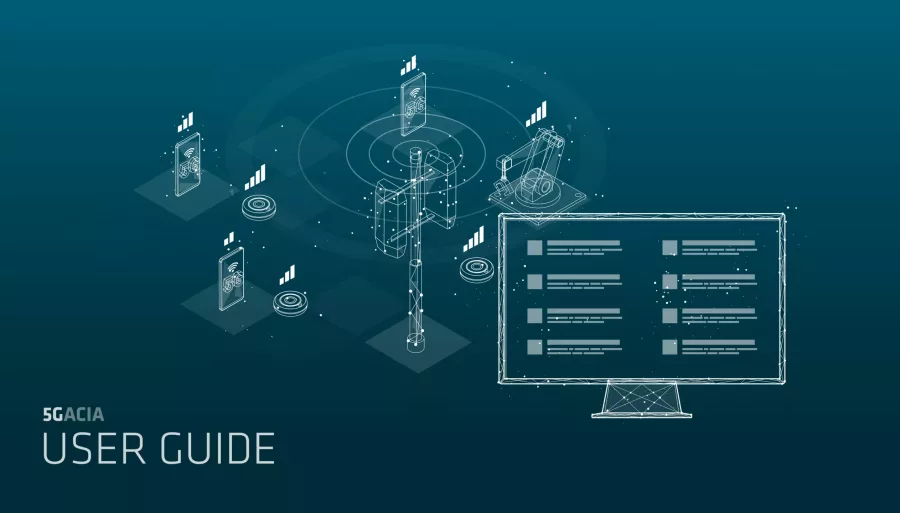
Internal time synchronization of the 5G network is a critical aspect of operating one’s own 5G non-public network (NPN). This includes time synchronization across various components within the 5G system, such as the 5G core (5GC) and the radio access network (RAN). It also involves synchronization between base stations and user equipment (UE).
Synchronizing the UEs with the rest of the 5G system is essential to ensure that messages are transmitted at the correct times, i.e., that the transmit frames are accurately aligned. Synchronization between base stations or the RANs of different or adjacent networks is crucial for aligning downlink and uplink time slots across networks, preventing interference between them. Further details can be found in the topic “Coexistence between public and non-public networks.” Precise synchronization is also important when using the 5G system as a TSN bridge within a TSN network. More information on time synchronization over 5G is available in the 5G-ACIA white paper “Integration of 5G with Time-Sensitive Networking for Industrial Communications.”
There are different methods to synchronize both the 5GC/RAN and the UEs. The two main ways to synchronize time for the 5GC and RAN are: via a GNSS connection and through PTP synchronization over Ethernet. Synchronization via GNSS is the standard approach, while PTP synchronization is less common and only possible if supported by the 5G system. The method used can be configured within the 5G system management tool.
UEs are typically synchronized via the 5G radio connection, which transports the time synchronization information. This is achieved using the primary and secondary synchronization signals. This form of synchronization occurs automatically when the UE first connects to a base station in the 5G network.
However, due to the asymmetry between downlink and uplink, and due to transmission time jitter, synchronization via this method does not provide the precision required for all industrial applications. For higher precision, a native 3GPP-specified mechanism must be used to synchronize the UEs. In this method, synchronization messages are adjusted based on uplink and downlink latency budgets, which are either known in advance or measured dynamically.