Frankfurt/Tokyo, February 2026 — On December 4, 2025, the 5G Alliance for Connected Industries and Automation (5G-ACIA) hosted the Industrial 5G Day 2025 at the Miraikan – National Museum of Emerging Science and Innovation in Tokyo. The event brought together international stakeholders to assess the current state of industrial 5G adoption, share realworld deployment insights, and explore concrete pathways toward scalable and widespread implementation.
Co-hosted with the XG Mobile Promotion Forum (XGMF), the conference highlighted how Industrial 5G is transitioning from trials and proof-of-concepts to productive deployments. Discussions underscored growing ecosystem readiness, while also identifying the remaining technical, regulatory, and operational challenges that must be addressed to enable large-scale industrial use.
“Industrial 5G Day in Tokyo was deeply meaningful for our community. Beyond roadmaps and pilots, we saw real traction toward commercialization of Industrial 5G—from working local and private 5G systems to production-grade use cases that improve quality, safety, and efficiency,” said Seiji Nishioka, Secretary General of XG Mobile Promotion Forum (XGMF). “This momentum reflects a growing ecosystem partnership in Japan and worldwide, and XGMF will continue to catalyze it.”
Reflecting the industrial perspective, Holger Schönherr, General Chair of 5G-ACIA, emphasized the growing relevance of Industrial 5G for today’s manufacturing and production environments: “Industrial 5G Day 2025 in Tokyo showed us that 5G is no longer a promise of the future; it is developing into a transformative force for industry today. The presentations clearly highlighted seamless 5G communication as a key success factor at a time when industries are under unprecedented pressure to become more flexible, efficient, and resilient.” He added, “This is exactly where the 5G Alliance for Connected Industries and Automation comes in: we are committed to shaping industrial-grade 5G communication and to working hand in hand with our ecosystem to pave the way toward data-driven and AI-enabled automation and ultimately toward the connected industries of tomorrow.”
The program opened with policy and ecosystem perspectives from organizations including Ministry of Internal Affairs and Communications Japan (MIC), XGMF, and the Alliance for Private Networks, addressing regulatory developments and the importance of international collaboration.
In the main technical sessions, experts from NTT East, Moxa, NS Solutions, Institute for Automation and Communication (ifak), Toyota Motor Corporation, AILINK, Siemens Japan, and Ericsson presented case studies covering proof-of-concepts, pilot projects, and practical deployments. Topics included network performance, system integration, and operational requirements in industrial environments.
The final session discussed the outlook of Industrial 5G, with speakers from Huawei, Druid Software, Fraunhofer IPT, the National Institute of Information and Communications Technology (NICT), and Nokia presenting perspectives on deployment models, system integration, and emerging industrial use cases.
Exhibition demonstrates current Industrial 5G solutions
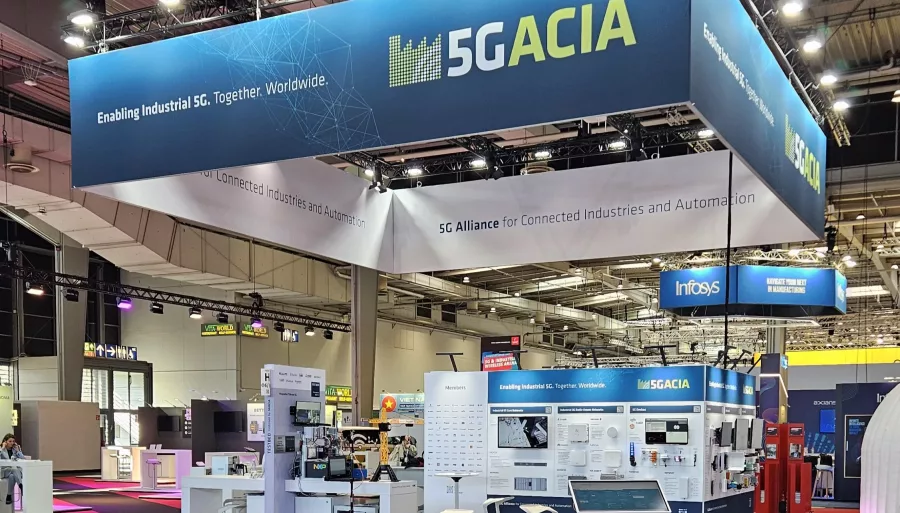
Alongside the conference program, an exhibition showcased Industrial 5G technologies and components currently available on the market. Companies including the Alliance for Private Networks, Belden, Druid Software, Ericsson, Nokia, NTT East, NTT Docomo Business, JRC, Magna Wireless, Mitsubishi Electric, NXP, Siemens, and Sumitomo Electric presented solutions such as private 5G networks, industrial 5G devices, and system integration concepts.
A central exhibit was the 5G-ACIA Demo Wall, which provided a cross-vendor overview of the current Industrial 5G ecosystem. The installation displayed market-available devices such as routers, dongles, and communication modules, helping industrial stakeholders better understand the building blocks required for end-to-end Industrial 5G deployment.
Industrial 5G Day 2025 addressed professionals working in industrial automation, operational and information technology, digital transformation, and telecommunications. The event was also relevant for policymakers, researchers, and organizations involved in adjacent fields such as robotics, edge computing, and smart manufacturing.
Building on the momentum of Industrial 5G Day 2025 in Tokyo, 5G-ACIA will continue its Industrial 5G engagement in Europe in 2026. 5G-ACIA will participate in Hannover Messe, as well as host an Industrial 5G Users Conference Day on May 28, in Frankfurt, alongside the 5G-ACIA Plenary. The conference will focus on industrial end-user perspectives, practical deployment experiences, and expanded demonstrations across multiple vertical sectors.
5G-ACIA welcomes industrial stakeholders, ecosystem partners, and interested organizations to join these upcoming activities and engage in the ongoing exchange on the deployment and future evolution of Industrial 5G.
About 5G-ACIA
The 5G Alliance for Connected Industries and Automation (5G-ACIA) is the central global forum for driving and shaping Industrial 5G. 5G-ACIA members jointly prepare for the disruptive transformation that 5G will bring, promote a better understanding of industrial needs, and gain insights into a rapidly expanding emerging market.
5G-ACIA provides a unique platform for OT and ICT companies, academia, and all relevant stakeholders to influence the development and deployment of 5G in line with industrial imperatives. With more than 80 member organizations, 5G-ACIA contributes its work directly to 3GPP – the leading standardization body for 5G worldwide.
5G-ACIA is a working party of ZVEI – German Electro and Digital Industry Association.
Press contact
Ms. Julia Sophia Bachmann
Phone: +49 162 2664905
Email: julia.bachmann@zvei.org